Mazda RX-7 FD3S Buyer's Guide 2026: The Rotary Tax, the Cooling Truth, and What to Pay
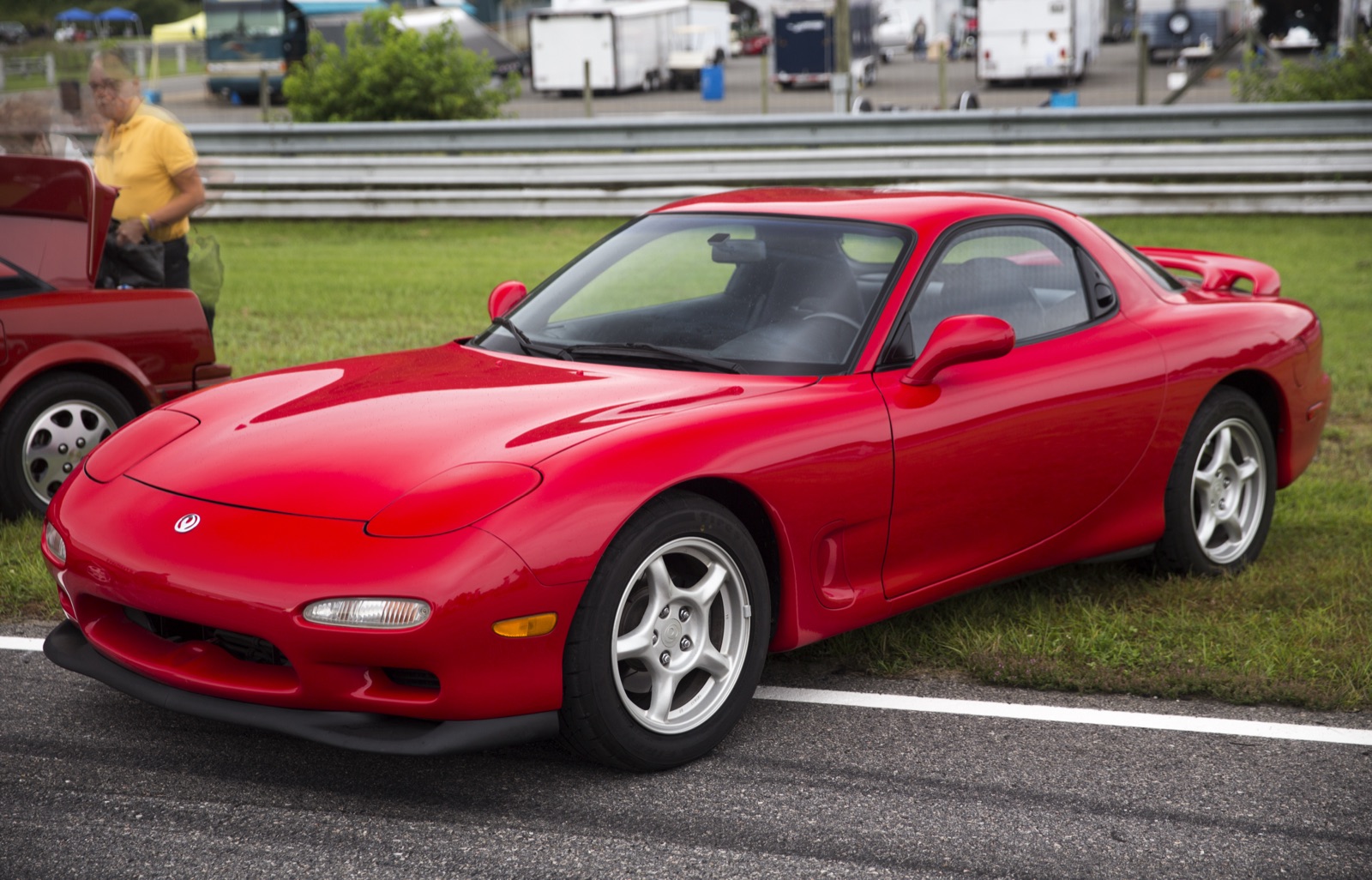
The third-generation Mazda RX-7, the FD3S, is the most beautifully proportioned Japanese performance car ever sold. Park one next to a 911, an NSX, a Supra MkIV, an R34. The FD’s hood, fenders and roofline form a single unbroken arc that none of those cars can match. Mazda’s chief designer in the early 1990s was told to build a sports car that looked good from every angle, and he delivered.
Styling is the easy part. What’s hard about owning an FD3S in 2026 is the rotary engine inside it, the sequential twin-turbo system feeding that engine, the marginal factory cooling system Japanese engineers spec’d in 1992 against tropical Tokyo summers, and the modification history of every used example currently for sale. No major JDM platform asks a higher entry tax. None pays out better when it’s right.
This is what to pay, what to inspect, and why a clean FD3S is worth twice what a not-clean FD3S costs.
US-Spec 1993–1995 vs Japanese 1992–2002
Mazda sold the FD3S in the United States for three model years: 1993, 1994 and 1995. The US-spec car had a 255-horsepower 13B-REW with sequential twin turbos, a five-speed manual, four-piston front brakes and a curb weight of around 2,800 pounds. About 13,800 examples were imported. After 1995, slow sales and an exchange-rate problem killed the US run.
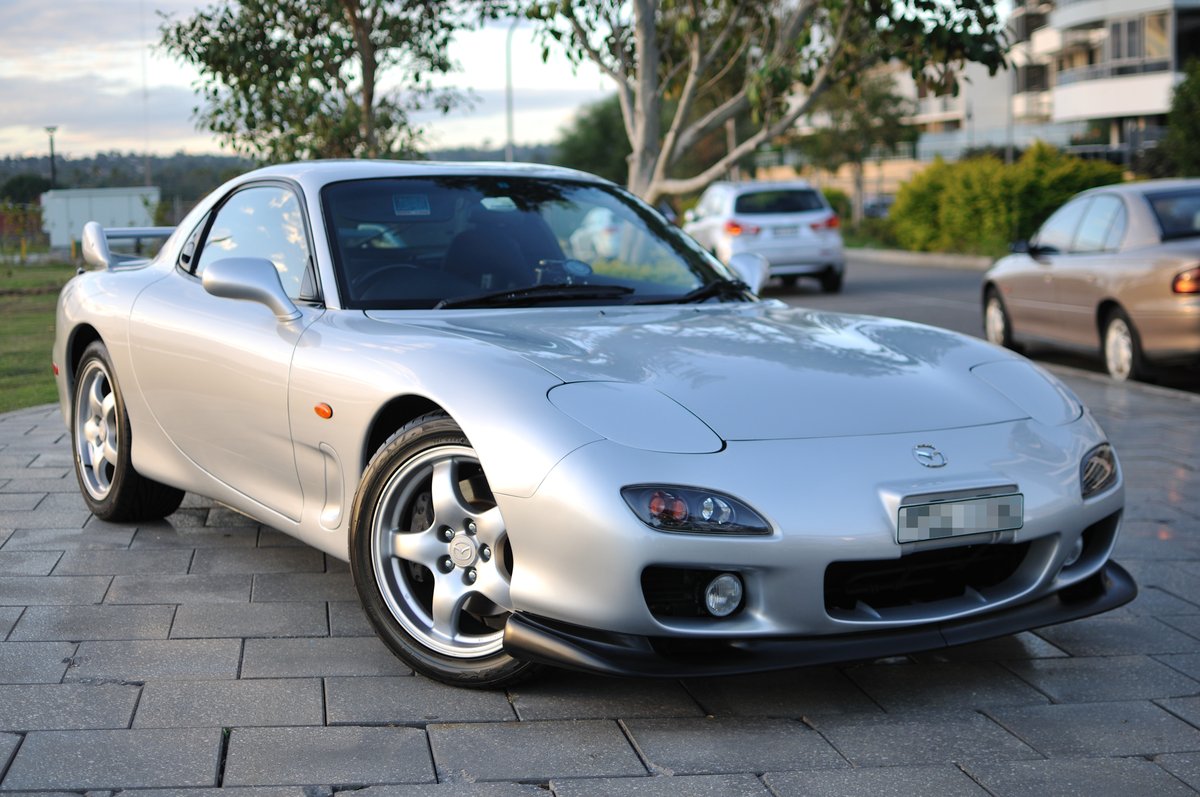
In Japan, Mazda kept building the FD3S until 2002. The Japanese-market cars went through five evolutions, gaining power, brake upgrades and suspension refinement, and at the very end a final special edition called Spirit R that has become the most valuable FD3S variant on the market. Series 6 (1992–1995) cars match what was sold in the US. Series 7 (1996–1998) and Series 8 (1999–2002) are JDM-only and progressively rarer in the US import market.
For 2026 buyers, the practical math:
- US-spec 1993–1995: most common, parts/service network strongest, prices most stable
- JDM Series 6: same drivetrain as US, but with JDM trim and right-hand drive
- JDM Series 7/8: improved suspension, brakes and cooling; harder to find, often imported from Japan in the past 5–7 years
- Spirit R (2002): final edition, 1,500 built, recognizable by recaro seats, BBS wheels, larger brakes, special-edition trim
US-spec cars are the rational buy. Spirit R is the irrational one. We’ll cover both.
The 13B-REW: What the Rotary Actually Costs
The 13B-REW is a twin-rotor Wankel displacing 1.3 liters of swept volume per rotation. Peak power arrives at 6,500 rpm, it redlines at 8,000, and it weighs roughly 100 pounds less than a comparable inline-six. It also wears in ways that have nothing in common with any piston engine you’ve owned before.
Internalize this before you shop: rotary engines are rebuild engines. Apex seals, the thin metal blades that keep the combustion chamber sealed as the rotor spins, wear continuously, and somewhere in the 80,000 to 120,000 mile range they need replacing. A proper rebuild includes new apex seals, side seals, corner seals and a careful look at the housings for chrome wear. Rebuild cost in 2026: $7,500–$12,000 from a competent rotary specialist, $15,000+ for a full performance build.
The inspection checklist for any FD3S you’re considering:
- Compression test using the proper rotary tester (Mazda RX-7 Compression Tester or equivalent; a piston-engine tester gives misleading readings on rotaries). A healthy 13B-REW makes roughly 7.0–8.0 kg/cm² (~95–110 psi) per face on each rotor, with the three faces of each rotor reading within 10% of each other. Anything below 6.5 kg/cm² (~92 psi) means worn apex seals and a rebuild on the horizon. Anything below 5.5 kg/cm² (~78 psi) is severe. Walk away unless the car is priced as a project.
- Cold start behavior: a healthy rotary fires immediately, idles smoothly within 10 seconds and produces minimal blue smoke. Excessive smoke at cold start means oil control rings failing. Hard hot starts mean compression loss.
- Oil consumption: rotaries consume oil by design (premix or an oil metering pump injects oil into the combustion chamber to lubricate the apex seals). Half a quart per 1,500 miles is normal. A full quart per 500 miles points to oil control problems.
- Coolant condition: pull the radiator cap cold. Sweet smell, oily film or brown sludge means a blown coolant seal, the rotary equivalent of a head gasket. Major job.
- Service records: premix vs. oil metering pump preference, last apex seal service, last cooling system service. A car with documented rotary specialist history is worth thousands more than one with mystery maintenance.
Budget 30% over your purchase price for the first 12 months of ownership. Most FDs need something. The well-maintained ones cost more upfront and less later.
The Sequential Twin Turbo System (And Why It Fails)
The 13B-REW’s sequential setup uses a small primary turbo that boosts from idle through about 4,500 rpm, at which point a larger secondary engages and carries boost to redline. Vacuum-actuated valves and a tangle of hoses manage the handoff. When it works, boost is seamless from 1,800 rpm onward. When it doesn’t, you get one of three failure modes.
Failure mode 1 — secondary turbo never engages. Most common. Vacuum line cracked or disconnected, charge control valve stuck. Symptoms: the car pulls strongly to ~4,500 rpm, then power flatlines. Fix: replace vacuum hoses, because the rubber lines have aged out and almost every FD needs new ones. Cost: $200–$500 in parts plus labor.
Failure mode 2 — secondary engages, then disengages erratically. Boost surge. Usually a sticking control valve or a bad solenoid. More work to diagnose; budget $800–$1,500 for proper repair.
Failure mode 3 — turbo bearings failing. Whining noise, blue smoke from the exhaust under load, oil in the intercooler piping. New OEM-spec turbos cost $1,800–$2,800 each. Aftermarket replacements (Garrett, BorgWarner) start at $2,000 per side. Single-turbo conversions are popular partially because of how expensive maintaining the twin sequential system has become.
Cooling: The Factory Compromise
Mazda spec’d the FD3S cooling system with margins that worked fine in 1993 Hokkaido and fail in 2026 Phoenix, Atlanta, or any track day above 80°F. Factory radiators are too small, factory fans struggle, and the sequential turbo system makes more heat than the airflow can move at low speeds.
Almost every FD3S in the US market has been cooling-modified. The required upgrades, and what each one tells you about the car in front of you:
- Aftermarket radiator (Mishimoto, Koyo, Greddy): almost universal. A car still on its factory radiator at 30+ years old either has very low miles or is about to overheat.
- Aftermarket cooling fans (electric, higher-CFM): common, and a sign of an owner who tracked the car or drove it in summer.
- Aluminum intercooler or upgraded charge pipes: visible in the engine bay. Not strictly necessary, but it signals an attentive owner.
- Engine oil cooler: the factory unit is undersized, so many cars have been upgraded to V-Mount or front-mount coolers.
A car with stock cooling that runs cool in summer is either A) very lightly used, B) being misrepresented, or C) about to fail catastrophically. Most sellers know this. Ask directly about cooling history.
Body, Chassis, and the Modifications Question
FDs survived the road salt years better than AE86s did. Most US-imported FDs are dry-state cars from California, Texas, Arizona or Florida. JDM imports vary more; Tokyo Bay humidity is real, but salt isn’t.
What to inspect:
- Rear quarters at the wheel arch: minor surface rust is common, perforation rare but not impossible
- Frame rails under the car, especially at the rear suspension mount points
- Battery tray and inner fender: same as every JDM car, this is the crevice that traps moisture
- Door bottoms and rocker panel seams
- Targa-top weather seal (if you’re buying an FD3S with the optional twin power-removable roof panels): old seals leak, and replacement runs $400–$600
On modifications, the FD3S market has split into two clear value tiers.
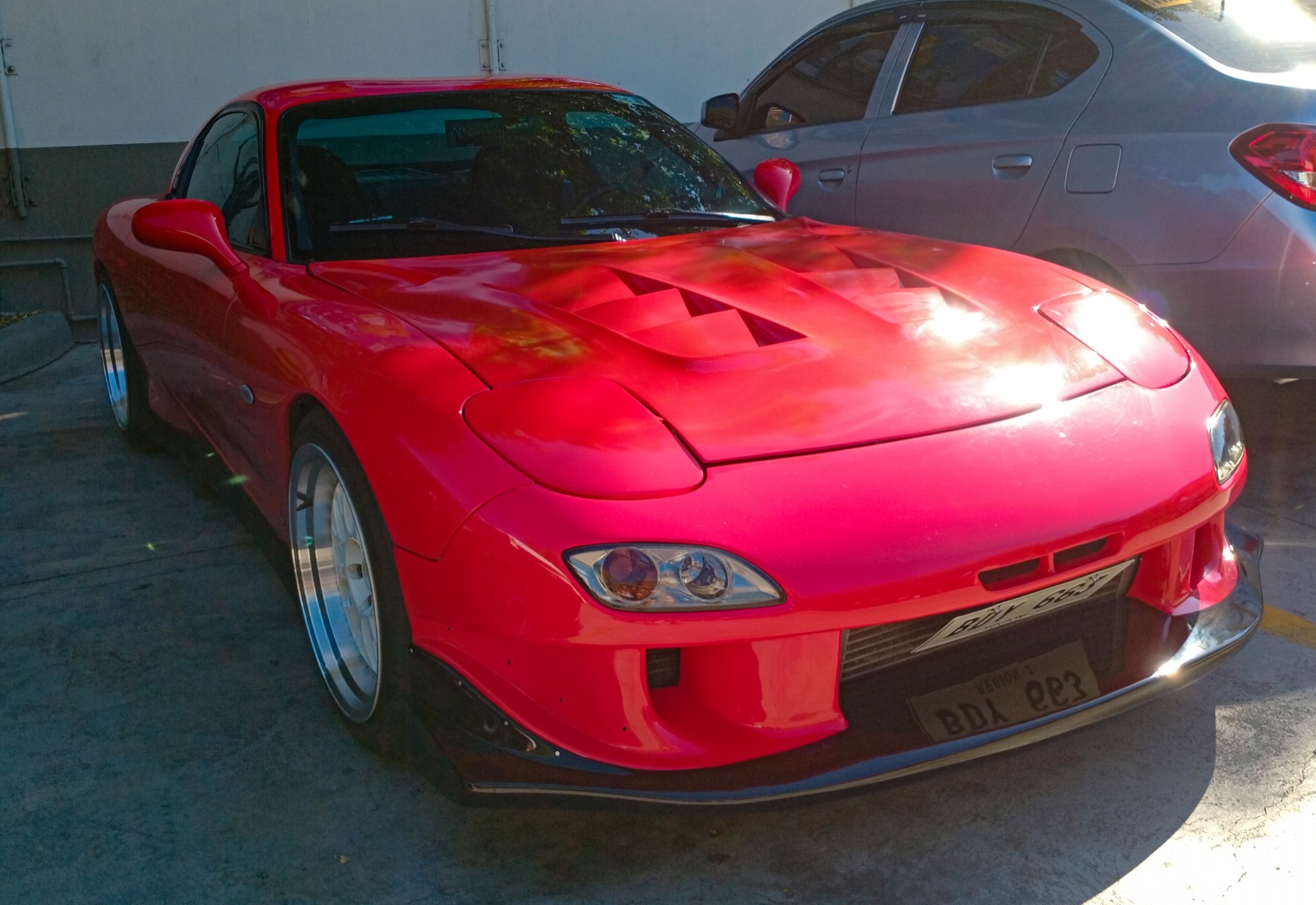
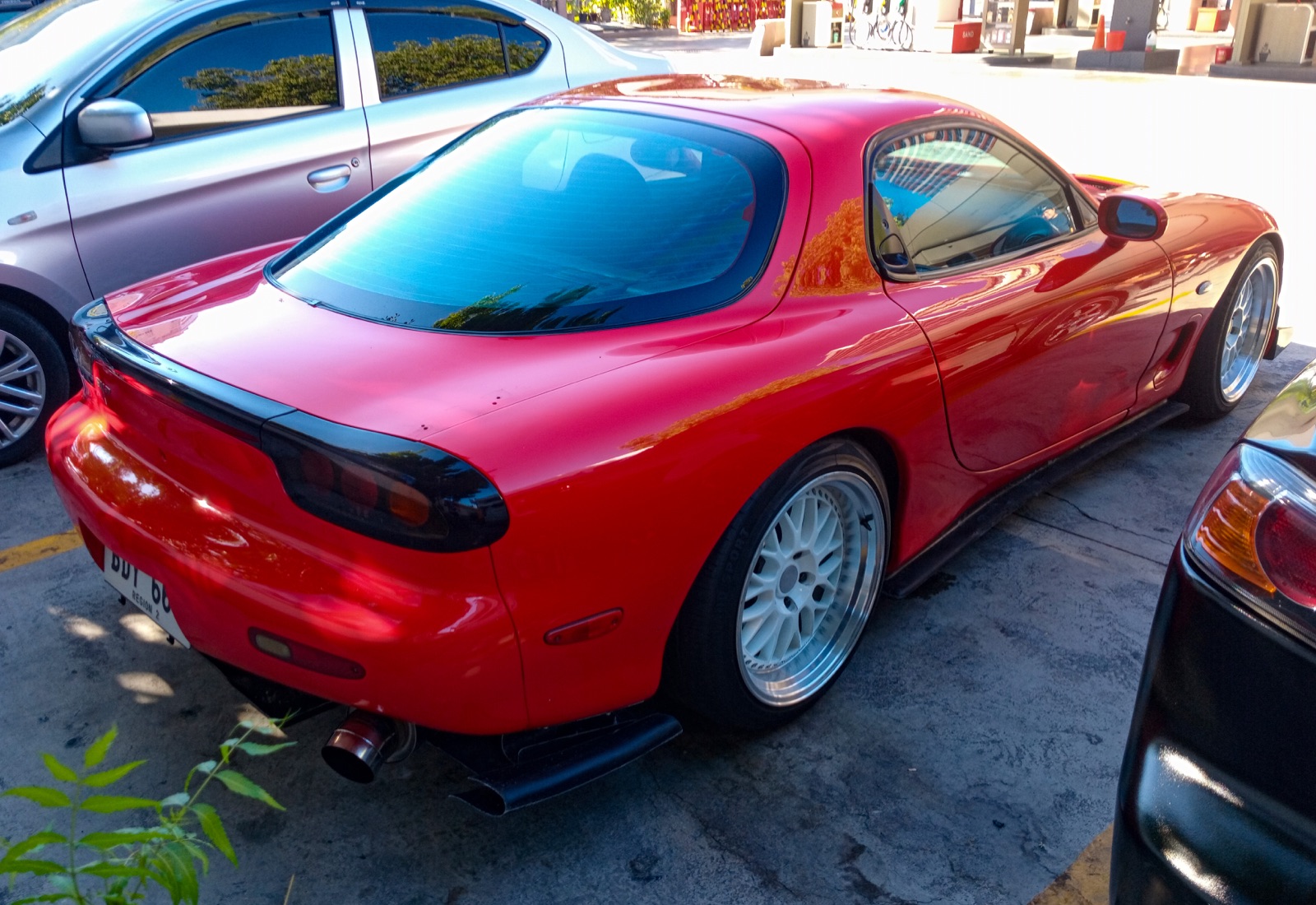
Tasteful modification covers high-quality coilovers (Ohlins, Tein, Bilstein), a mild ECU tune, intake and exhaust, cooling upgrades, period-correct wheels (RE Amemiya, Volk TE37). Value-neutral or slightly positive. Buyers expect this on a 30-year-old turbocharged rotary.
Heavy modification means single-turbo conversion, race seats, roll cage, stripped interior, big-power tunes. That pushes a car firmly into track-car territory and caps value at $35,000–$55,000 no matter how good the build is. The unmodified, stock-twin-turbo FD3S is now the rarer and more valuable car.
What to Pay in 2026
Real market data, sourced from BringATrailer auctions and Cars and Bids comps from late 2025 through early 2026:
- US-spec 1993–1995, driver-grade with mods: $30,000–$50,000
- US-spec, clean original, lower miles: $50,000–$80,000
- US-spec, restored or museum-grade: $80,000–$130,000
- JDM Series 6/7, driver-grade: $40,000–$65,000
- JDM Series 8, clean: $70,000–$110,000
- Spirit R (2002 final edition): $130,000–$220,000+
Spirit R prices have been climbing 8–12% annually since 2022. Low production (1,500 units), final-edition status and Wankel-engine extinction (no manufacturer is making rotary sports cars in 2026) add up to structural scarcity. Find a documented Spirit R under $150,000 in 2026 and you’re looking at a strong appreciation play.
Insurance and Ownership Reality
Agreed-value classic policies through Hagerty, Grundy and American Modern handle the FD3S well. Premiums on a $60,000 agreed value run $600–$1,000 per year for low-mileage policies (3,000–5,000 mi/year). Spirit R policies at $180,000+ agreed values run $1,800–$3,000.
Daily driving an FD3S is a different conversation. Standard policies will cover it, but given the rotary’s reliability profile you should plan on at least one major service event every 3–5 years. Call it $3,000–$6,000 per year in maintenance for a sorted, daily-driven FD. Plus tires, because the FD eats them, plus fuel and the oil that premix or the metering pump keeps burning.
For a casual weekend car kept in a garage, ownership costs drop to $1,500–$2,500 annually until the next apex seal service comes due.
Where to Buy
BringATrailer and Cars and Bids: most clean FD3S transactions in the US run through these auctions. Pricing is honest, photography is thorough, and the comments sections are surprisingly informative, because the FD community is small and well-informed.
Direct from Japan via importer: Toprank Importers, JDM Sport Classics, JDM Buyer’s Club. Budget 12–16 weeks from auction win to US delivery. Prices typically run 15–25% below US auction comps for equivalent condition. The risk is buying without an in-person inspection.
RX7Club.com classifieds and the FD3S subreddit: knowledgeable enthusiast sellers, often with deeply documented service histories. Best for buyers who already understand the platform, risky for first-time rotary owners who don’t yet know what to look for.
The Bottom Line
The FD3S is not a casual purchase. The cheapest examples are project cars, the median examples need work, and the clean originals cost real money in 2026. Buy carefully and the reward is a car that drives like nothing else on the road: a steering feel, throttle response and chassis balance no piston-engined competitor of any era has matched.
First-time rotary owner? Target a US-spec 1994–1995 car with documented apex-seal-service history, aftermarket cooling and 60,000–90,000 miles. Budget $50,000–$70,000 to buy, $5,000–$10,000 in deferred maintenance the first year. If you’re chasing the Spirit R, work with a specialist importer and a pre-purchase inspector who knows rotaries. The unicorn premium only holds if the car is genuinely unicorn-condition.
For the broader JDM market context, see The 5 JDM Cars That Changed Everything. For the editorial perspective on what makes the FD3S the soul of the rotary era, read Mazda RX-7 FD: A Love Letter to the Rotary.
More JDM buyer’s guides: Toyota AE86 buyer’s guide · Nissan R32 GT-R buyer’s guide
Share this
Join the conversation
COMMENTS
Loading comments…
No comments yet. Be the first to weigh in.
Leave a comment
Posted
Thanks for joining the conversation.