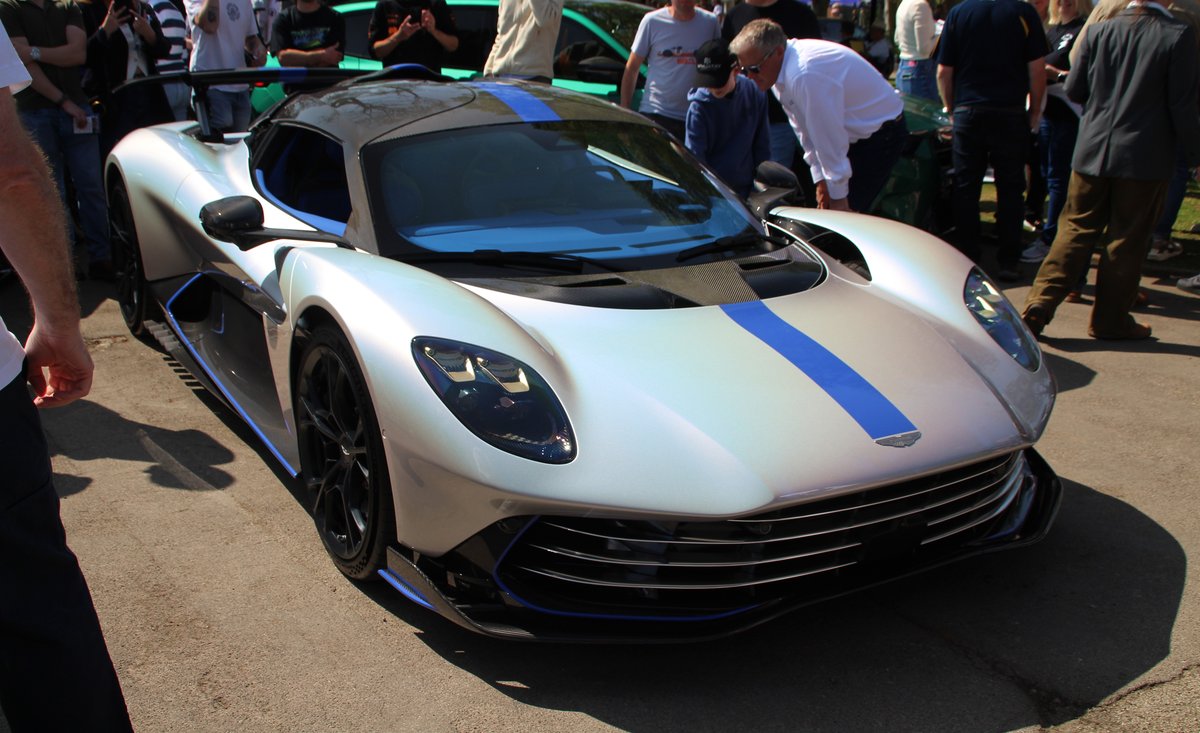
The Aston Martin Valhalla: F1 Technology, Road Legal, 1,000 Horsepower
Aston Martin spent years promising a mid-engine hypercar. The Valhalla is the one that actually got built.
1,064 horsepower. 1,550 kilograms. 0 to 60mph in 2.5 seconds. 217mph. Those are the numbers, and the story behind them is the better part.
Aston’s History With Mid-Engine Cars
Aston’s identity was built on front-engine grand tourers. The DB series. The Vantage. The DBS. Long bonnets, inline-sixes or V12s sitting up front, drive to the rear wheels, built for the sort of person who drives from London to Monaco and wants to arrive looking appropriate.
There had been attempts at mid-engine cars before, none of them consistently successful. The mid-engine Valhalla concept debuted at the 2019 Geneva Motor Show with an Aston-developed hybrid V6 that was never going to see production. The concept was striking, and the F1 safety car collaboration with Red Bull Racing made headlines, but the original powertrain died quietly in Aston’s restructuring.
What came out the other side was better. When the production car was confirmed in 2021, it carried something else entirely: the AMG 4.0-litre twin-turbocharged V8, the engine Aston had been fitting to the Vantage and DB11 since the AMG partnership began. This is not the Vantage version of that engine. It shares a block and very little else.
Aston had reached for this before. Each time, circumstances got in the way. The Valhalla is what it looks like when the company finally gets all the way through.
The AMG Partnership — What It Actually Means
Mercedes-AMG and Aston Martin have had a technology partnership since 2013. In practice: AMG supplies engines and infotainment, Aston handles chassis, structure and dynamics. Transactional, in the best sense of the word. Each side contributes what it’s good at.
The Valhalla’s 4.0-litre twin-turbo V8 makes 750hp from the combustion engine alone. That’s above the AMG GT Black Series (730hp) and above the GT2 (740hp). Aston’s is the hottest version of this engine anywhere.
Two electric motors add another 295hp, one per front wheel, for a combined 1,064hp. Power is almost a side effect. The front motors exist for torque vectoring, and by modulating torque between the front wheels independently, the Valhalla can steer itself through a corner with a precision no mechanical differential will ever match.
The V8 drives the rear wheels through an eight-speed dual-clutch gearbox. The electric motors drive the front wheels directly. So the four-wheel drive system works on a fundamentally different principle from traditional mechanical all-wheel drive: the axles are completely decoupled from each other except through software.
That’s the substance behind “F1 technology” here, and it’s a different philosophy from what Gordon Murray did with the McLaren F1. Murray took technology away; Aston added the right kind. The car doesn’t use F1 parts. What it borrows is the thinking: that controlling individual wheel torque in real time is the foundation of how a car handles, and that the control has to happen in software, faster than any mechanical system can respond.
The Carbon Monocoque
The structure is a carbon fibre monocoque Aston developed with outside specialists. Total weight with it: 1,550kg. For a 1,064hp hybrid, that is light.
Suspension is pull-rod at both ends, lifted straight out of Formula 1 practice. Pull-rod puts the actuating hardware low in the chassis, which drops the centre of gravity and helps packaging. It also demands geometry engineered to considerably tighter tolerances than a conventional setup. Worth the trouble: the Valhalla holds near-perfect camber through the full range of suspension travel.
Brakes are Brembo carbon-ceramics, 398mm rotors up front, six-piston calipers. They resist fade at temperatures that would destroy steel rotors, and they’re lighter besides. For a car that’s going to spend real time on circuit, there wasn’t another sensible answer.
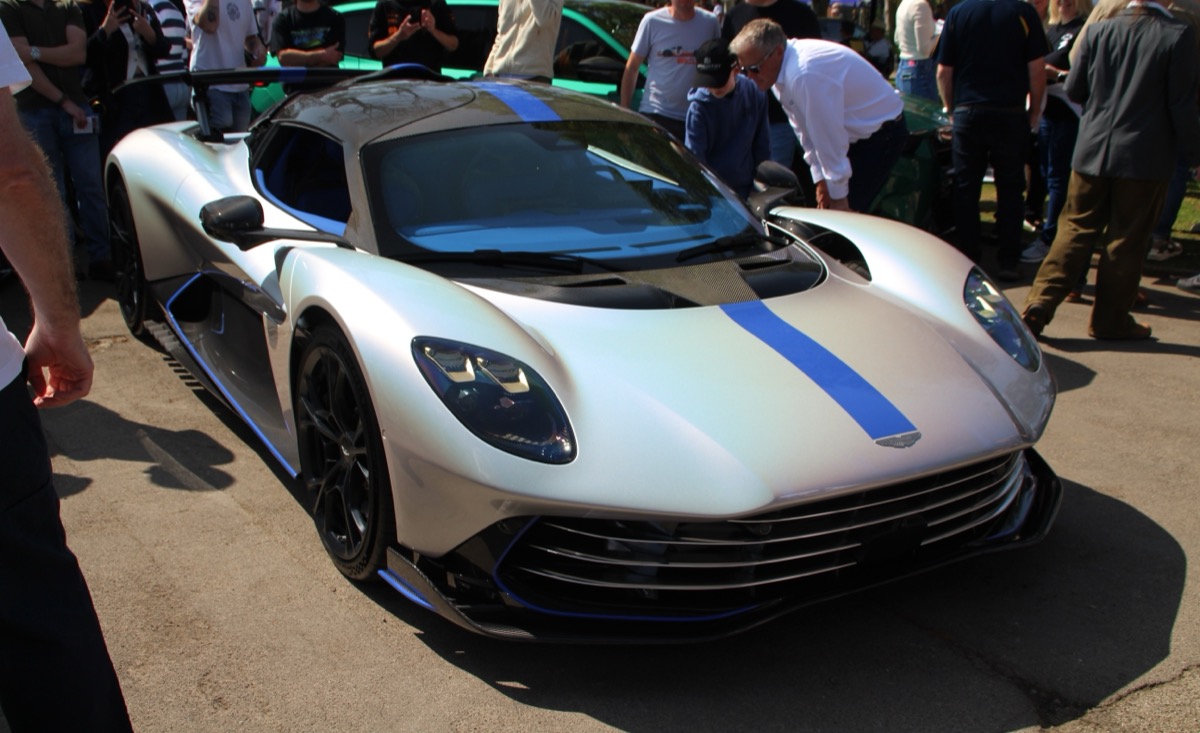
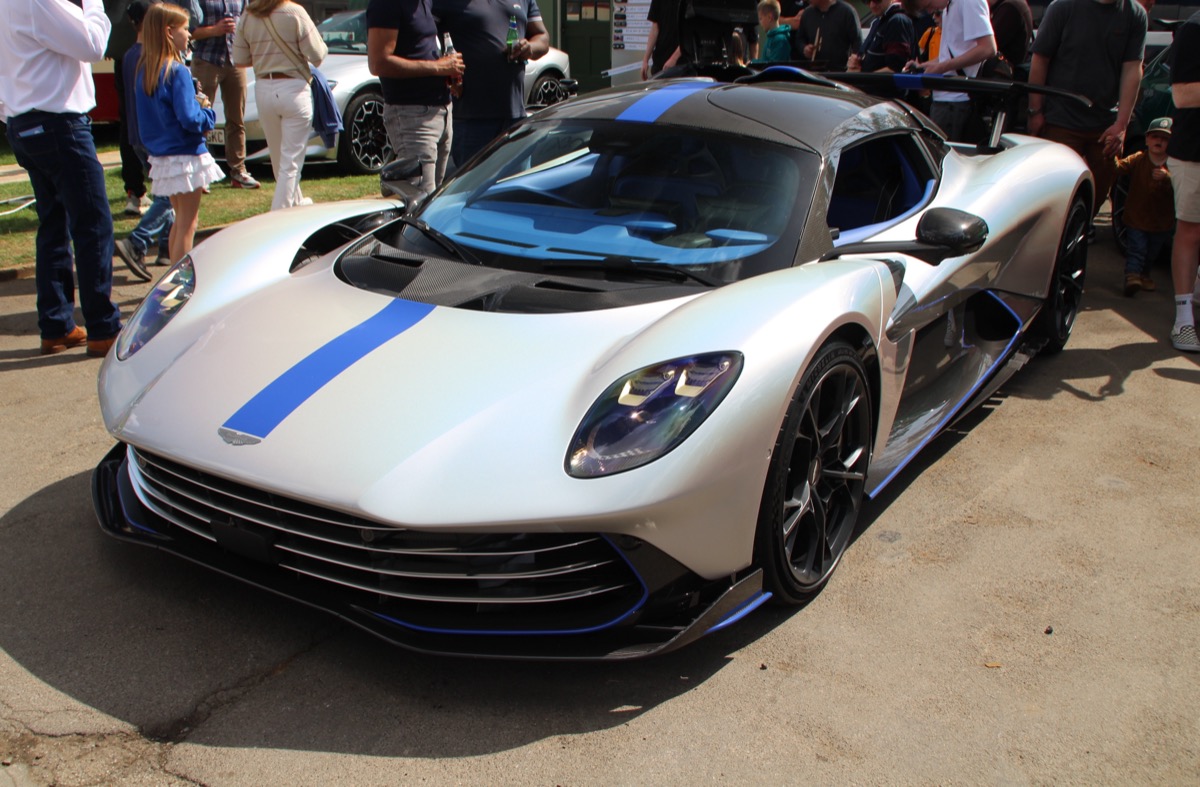
The aerodynamics do a job rather than a performance. Front splitter, underbody floor feeding a rear diffuser, active rear wing that adjusts for speed and cornering load. Meaningful downforce, and yet the car doesn’t look like someone raided a Le Mans prototype for parts.
Why This Matters for Aston Specifically
Every car manufacturer has a theory of itself. Ferrari’s theory is that it builds the world’s greatest sports cars. Lamborghini’s, that it builds the most dramatic ones. Porsche’s, that it builds the most engineered ones.
Aston Martin’s theory is harder to articulate. Beautiful cars, certainly. Grand tourers, yes. But the badge has always carried a promise that the front-engine GTs only ever half honoured, the promise of something genuinely extreme. The promise implied by the name Aston Martin Valkyrie, the Adrian Newey-designed hypercar that operates at levels beyond the reach of ordinary drivers, except delivered here in a car that doesn’t require an Adrian Newey driving school to get anything out of.
The Valhalla sits below the Valkyrie in Aston’s lineup. It takes the Valkyrie’s philosophy and translates it into something a very accomplished driver can actually use. 1,064hp, 1,550kg, the same structural thinking, minus the near-F1 extremity.
Nothing Aston has built mid-engine has ever been this technically serious. Nobody moved the engine for novelty’s sake, either. This is a hypercar worked out from first principles, with the engine amidships because the physics says so, the suspension derived from motorsport because lap times say so, the carbon structure there because the weight target left no other option.
What “F1 Technology” Means and Doesn’t Mean
Every manufacturer says “F1 technology” in press releases. The phrase has been drained of meaning. The Valhalla is good enough to deserve having it unpacked rather than simply deployed.
What’s real: the aerodynamic development happened in the same computational fluid dynamics environment Aston’s F1 programme uses. The suspension geometry was informed by the same engineers working on the AMR21. The torque vectoring software came from people who understand how an F1 car manages traction.
What isn’t: the Valhalla doesn’t run the same tyres, the same suspension components, the same power-to-weight ratio or the same downforce-to-drag figures as a Formula 1 car. It won’t pull the same lateral acceleration. It won’t lap a circuit anywhere near the same time.
What the phrase does communicate is a way of working. The people who designed and built this car approached the problem the way F1 engineers approach problems. They started with physics and worked toward road legality, instead of starting with a road car and bolting on circuit pretensions.
That matters. That is a different car.
The Car the Badge Promised
Aston Martin has produced beautiful cars for over a century. The DB4, the DB5, the DB9, the One-77. Cars that justify the existence of the brand. But every one of them was built around a particular idea of what a car should be: beautiful, fast in a GT sense, ultimately comfortable.
The Valhalla answers to a different set of priorities altogether. Downforce, weight, structural stiffness, power-to-weight ratio, the ability to exploit a circuit. A hypercar.
Aston Martin needed to build it. The badge has always carried the weight of a promise the front-engine lineup couldn’t completely fulfil, the promise of genuine extremity, of a car built without compromise, performance first and performance last.
The Valhalla is that car.
It took them long enough.
Share this
Join the conversation
COMMENTS
Loading comments…
No comments yet. Be the first to weigh in.
Leave a comment
Posted
Thanks for joining the conversation.