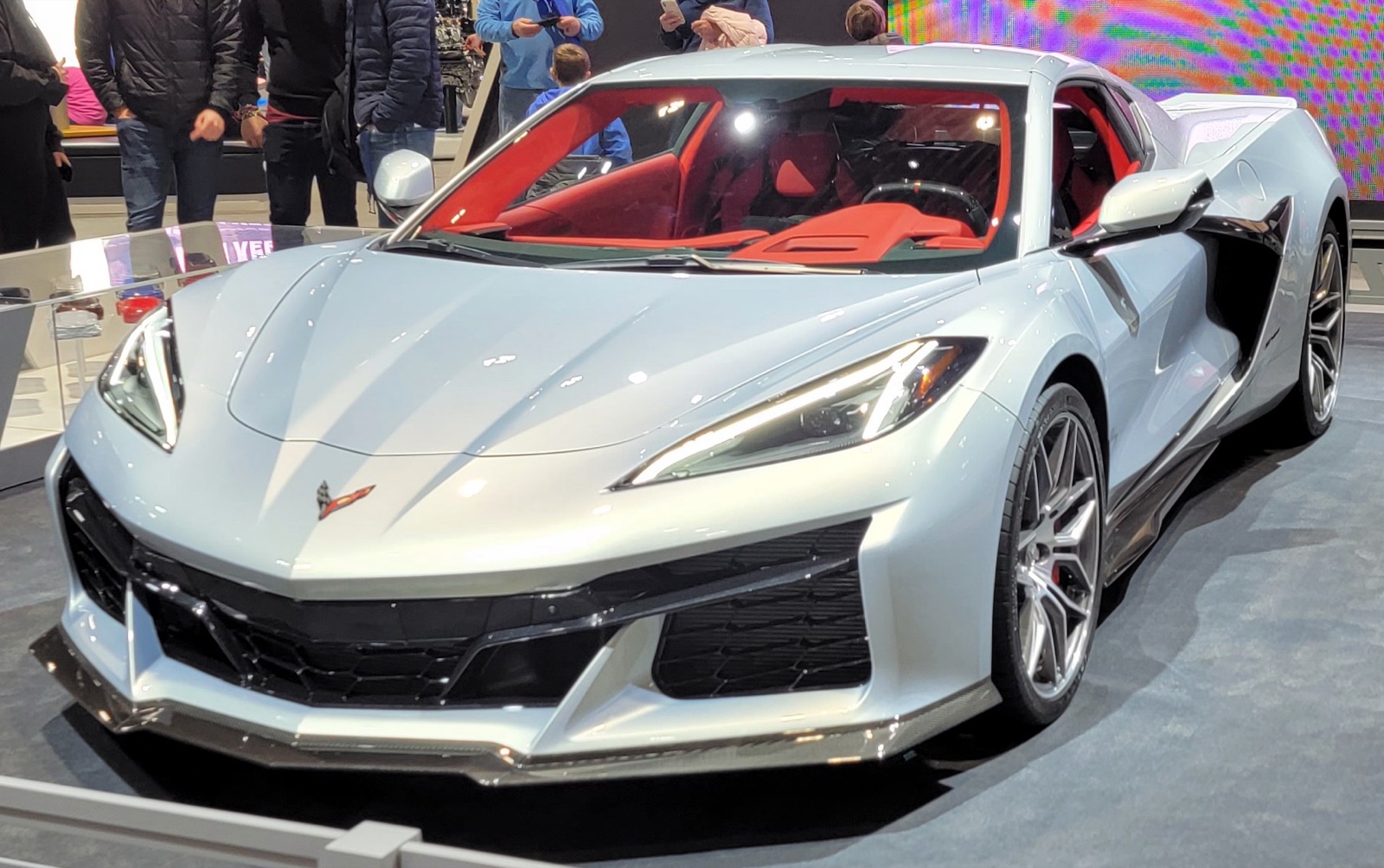
Corvette C8 Z06: The Mid-Engine American Finally Grows Up
The 2023 Chevrolet Corvette C8 Z06 makes 670 horsepower from a 5.5-litre naturally aspirated V8. It revs to 8,600 rpm. It uses a flat-plane crankshaft. It is mounted behind the driver in a mid-engine layout. It costs $115,000 to start.
Every one of those specifications, taken individually, would be unremarkable on a Ferrari 488 Pista or a McLaren 600LT. Taken together, on a single car, at that price, from an American manufacturer that had built front-engine pushrod V8 Corvettes for sixty-eight consecutive years, they represent the most consequential redesign in American supercar history.
This is the story of how General Motors finally answered the question its own engineers had been asking since the late 1980s: can the Corvette compete on European supercar terms without losing what made it a Corvette? The answer, in 2023, was yes. And the engine they used to prove it deserves its own chapter.
The Sixty-Eight-Year Identity Problem
The Corvette has existed in some form since 1953. Across that span, it has used a front-engine, rear-wheel-drive, pushrod-V8 architecture as its defining engineering specification. The architecture has been refined exhaustively — the 1997 C5 introduction of the LS-series small-block is one of the most significant performance engineering advances in any American car program. The C6 ZR1 and C7 ZR1 produced 638 and 755 horsepower respectively from supercharged versions of that same architecture. The cars were fast. They were also, recognizably, Corvettes.
The problem was that “recognizably a Corvette” had become a ceiling rather than a foundation. By the late 2010s, the front-engine layout was the limiting factor on what GM could engineer. The weight distribution couldn’t get more aggressive without compromising daily usability. The aerodynamics couldn’t pull more downforce without making the car ugly. The supercharged V8 had reached the practical limit of what could be done with pushrod architecture in a road car. To build something that competed with current Ferrari and McLaren product, the architecture itself had to change.
The decision was generational. Tadge Juechter, the Corvette’s chief engineer since 2006, championed the mid-engine redesign through internal review processes that took the better part of a decade. The program was approved during the late stages of the C7’s run. Engineering work began in earnest in 2014. The C8 launched in 2020 — first as the Stingray, then as the Z06 in 2022 model year (with cars arriving in dealerships through 2023). The architecture change ended sixty-eight years of front-engine Corvettes and opened a new era that would define the next several decades of the platform.
The LT6 — The Engine That Justifies Everything
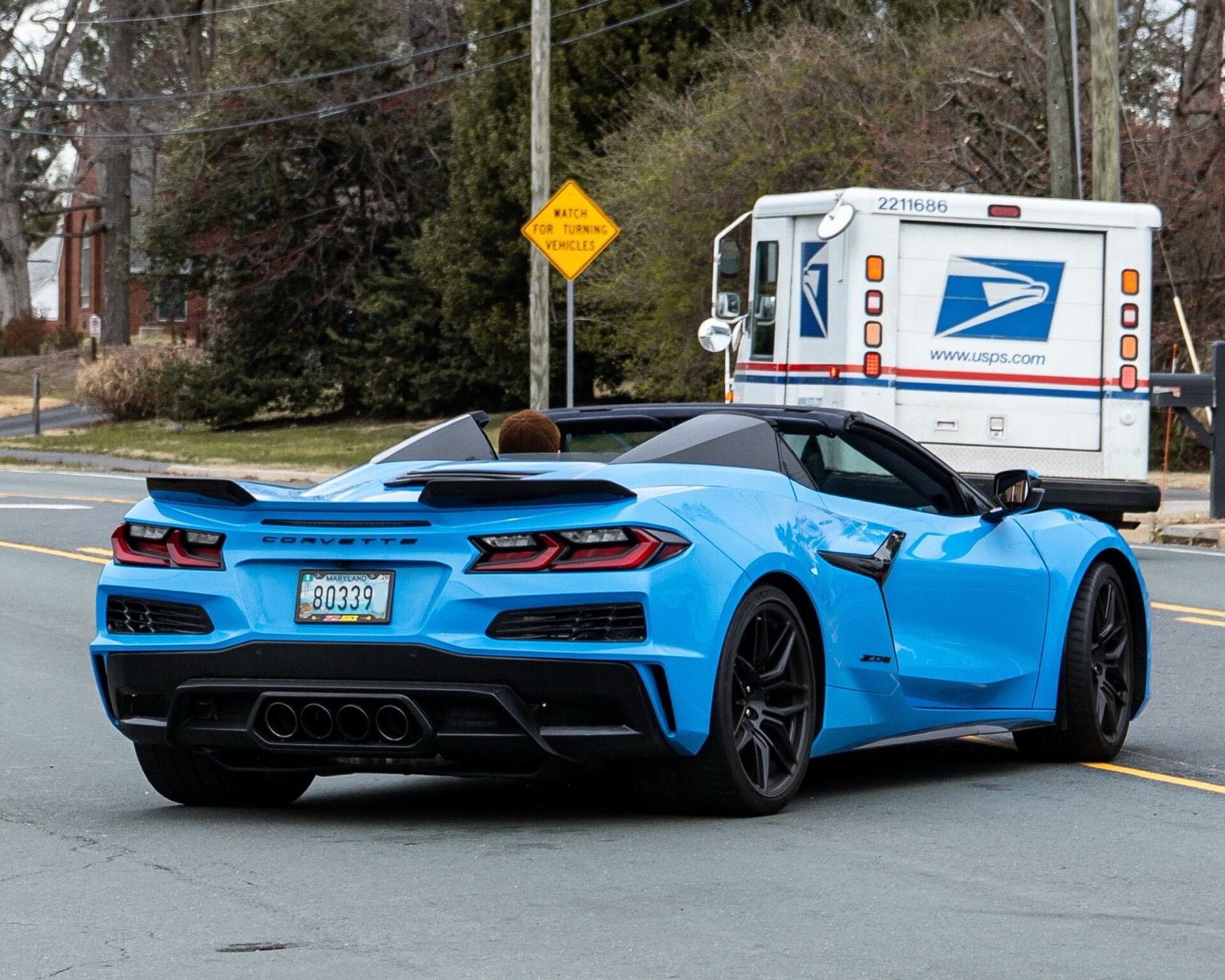
The Z06’s engine is the part of the car that most cleanly explains why it deserves attention from outside the Corvette community.
The LT6 is a 5.5-litre dual-overhead-cam, 32-valve, flat-plane crankshaft V8. It produces 670 horsepower at 8,400 rpm and 460 lb-ft of torque at 6,300 rpm. It revs to 8,600 rpm. It is the most powerful naturally-aspirated production V8 in the world.
To understand why those specifications matter, consider what they replace. The C7 Z06’s LT4 was a 6.2-litre supercharged pushrod V8 producing 650 horsepower at 6,400 rpm. The redline was 6,500 rpm. The torque curve was characteristic of supercharged American V8s — enormous low-end thrust that flattened off as revs climbed. The LT4 was an extraordinary engine. It was also, architecturally, an old engine.
The LT6 is the opposite of the LT4 in nearly every way. Naturally aspirated where the LT4 was supercharged. Dual overhead cams where the LT4 used pushrods. Flat-plane crankshaft where the LT4 used a cross-plane. 8,600 rpm redline where the LT4 stopped at 6,500. The LT6’s torque curve climbs steadily and peaks high — power delivery characteristic of European exotic engines, not American muscle engines.
The flat-plane crank is the architectural signature. Cross-plane cranks (the conventional American V8 layout) produce the muscle-car burble — uneven exhaust pulses generate the characteristic rumble. Flat-plane cranks fire the cylinders in evenly-spaced intervals. The exhaust note is a high, metallic, screaming sound — like a Ferrari V8 — because the underlying combustion physics is the same. The 488 GTB and the F8 Tributo use flat-plane cranks. The Aston Martin Vantage AMR uses one. The McLaren MP4-12C and 570S use one. Now the Z06 uses one. American.
The engine was developed in part by GM Powertrain engineering with input from the Cadillac CTS-V Le Mans racing program — the Cadillac engineers who’d designed track-specific flat-plane V8s for endurance competition were brought into the production engineering program. The LT6 you can buy for $115,000 is, architecturally, a detuned race engine. It is hand-assembled at GM’s Performance Build Center in Bowling Green, Kentucky, by a single technician per engine, who signs the engine plate.
That engine, alone, would justify the C8 Z06’s existence. Everything else the car does is built on the foundation it provides.
The Mid-Engine Architecture
The shift to a mid-engine layout was the C8 program’s biggest engineering bet, and the part of the design that required the most institutional courage.
A mid-engine car distributes weight differently than a front-engine car. Polar moment of inertia decreases — the car rotates more readily. Weight transfer under braking and acceleration changes — different chassis tuning, different suspension geometry, different tire wear patterns. The driving experience is fundamentally different. Owners of front-engine cars who switch to mid-engine cars often report the first hour of ownership is spent recalibrating expectations of how the car moves.
The C8 Z06 sits on a chassis derived from the Stingray’s mid-engine architecture but extensively modified for track duty. Wider track. Stiffer springs and dampers. Larger brakes. Reworked aerodynamics. The suspension uses double wishbones front and rear with magnetic ride control as standard equipment — the magnetorheological dampers that GM has refined across multiple Cadillac and Corvette generations are still some of the best adaptive damping technology in any production car at any price.
The chassis stiffness is achieved through aluminum extrusions, castings, and stampings welded into a unibody structure with substantial structural reinforcements compared to the Stingray. The Z06-specific changes to the chassis added approximately 100 pounds — small in absolute terms, significant when every kilogram is fought for at the supercar level.
The wheels are 20-inch front and 21-inch rear. The tires are Michelin Pilot Sport 4S as standard, Pilot Sport Cup 2 R as the Z07 package option. The brakes are six-piston front, four-piston rear — Brembo carbon ceramic with the Z07 package, steel rotors as standard.
This is European supercar architecture executed with American manufacturing precision. None of it is exotic by Ferrari standards. All of it is class-leading by American standards.
The Z07 Performance Package
The Z06 by itself is the most extreme Corvette ever built. The Z07 Performance Package makes it more extreme.
Z07 adds: carbon ceramic brakes (saving approximately 50 pounds of unsprung mass), Michelin Pilot Sport Cup 2 R tires, a more aggressive front splitter, dive planes on the front fenders, a fixed rear wing, and revised chassis settings tuned for circuit driving. The package costs roughly $8,000–10,000 depending on the year and trim configuration.
The aerodynamic package is what makes the Z07 a different car than the standard Z06. The standard Z06 generates approximately 365 pounds of downforce at 186 mph. The Z07-equipped car generates approximately 734 pounds of downforce at the same speed — more than double, the result of the front splitter, fender dive planes, and the fixed rear wing all working in concert.
The downforce difference is felt at speed. Below 100 mph, the two cars feel similar. Above 120 mph, the Z07 settles into the road in a way the standard Z06 doesn’t. At 150 mph and above — speeds reached only on track — the Z07 generates enough aerodynamic load that the suspension is compressed beyond its static state. The driver feels a planted, stable, predictable car. The standard Z06, at the same speed, feels lively and nervous in comparison. Both are correct interpretations. The Z07 is the track car. The standard Z06 is the road-and-track car. Most buyers who plan to track the car opt for the Z07.
The carbon ceramic brakes are the unsung hero of the package. Standard steel rotors fade after roughly four to six laps of aggressive track use. The carbon ceramics maintain stopping power lap after lap and survive multiple track days without degradation. For a car that will see real circuit use, the brake upgrade alone justifies the package cost.
The Nürburgring Statement
In late 2023, Chevrolet released telemetry-verified Nürburgring Nordschleife data for a Z07-equipped C8 Z06.
The lap time was 7:13.9.
Numbers without context are meaningless, so the context: the C7 ZR1 — the previous most-extreme Corvette, with 755 supercharged horsepower — lapped the same circuit in 7:18.1. The Z06 is faster despite producing 85 fewer horsepower, on a naturally-aspirated engine, on a chassis that GM had no prior mid-engine experience with at the time of design.
For comparison: the Porsche 911 GT3 RS (current generation) runs the Nordschleife in approximately 6:49.3. The Lamborghini Huracán STO runs it in approximately 6:59. The McLaren 720S runs approximately 7:15. The Z06 is slower than the GT3 RS and the Huracán STO, which cost approximately $240,000 and $330,000 respectively. The Z06 is faster than the McLaren 720S, which started at approximately $300,000 new.
The Z06’s lap time is mid-pack among current track-focused supercars and ahead of cars costing two to three times as much. The point isn’t that the Z06 is the fastest car around the Nordschleife. The point is that an American manufacturer, on its first mid-engine production program, hand-assembled the engine in Kentucky and shipped a car that competes on circuit performance with Italian and German cars costing two to three times more. That is the engineering achievement, and it is unambiguous.
What This Means in the American Supercar Story
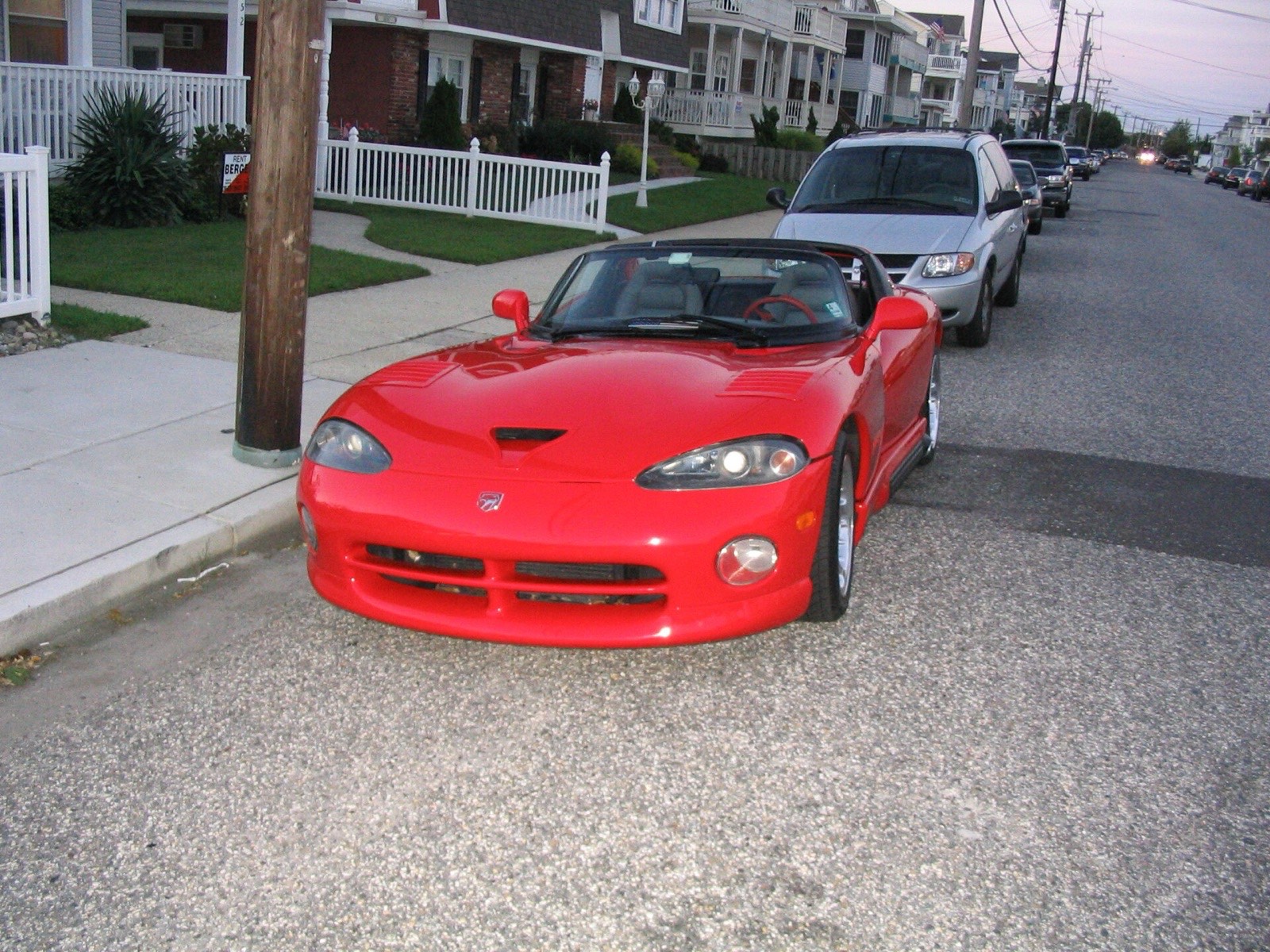
The C8 Z06 is the second time an American manufacturer has built a globally credible supercar. The Dodge Viper was the first. The Z06 closes a chapter the Viper opened.
The Viper proved that an American company could build a supercar by deliberately rejecting European philosophy — V10, manual, no driver aids, made in Detroit. The car ran for twenty-five years on that thesis and ended in 2017 because the regulatory environment couldn’t accommodate it any longer. The Viper exited on its own terms, but it exited.
The Z06 takes the opposite approach. Where the Viper rejected European philosophy, the Z06 absorbs it — flat-plane V8, mid-engine, electronic stability control, automatic transmission, modern aerodynamics — and applies American manufacturing scale and American value engineering to deliver the European specification at half the price. The Z06 isn’t trying to be different from the Ferrari. It’s trying to be the Ferrari, made in Bowling Green, sold for $115,000.
The cultural implications are large. The Viper’s audience was a specific kind of American supercar buyer — the type who wanted nothing to do with European exotic ownership culture. The Z06’s audience is broader, more affluent, more willing to compare directly against European product. The Z06 is being cross-shopped against the 911 GT3 and the Audi R8 — sometimes against the Ferrari 488 and the Lamborghini Huracán. The Viper was never seriously cross-shopped against any of those cars.
That broader audience matters because it changes what GM can do next. The C8 ZR1, expected to deliver 1,000+ horsepower with a hybrid system or twin-turbocharged variant of the LT6, is the natural progression. A C8 Zora — the rumored top-of-range model with electrified front axles for AWD performance — sits above that. GM is, for the first time in Corvette history, planning a multi-tier supercar lineup that competes directly with the Lamborghini Huracán/Aventador hierarchy and the Ferrari F8/SF90 hierarchy.
The Z06 is what makes that lineup possible. Without the engine and the chassis and the price-to-performance ratio it establishes, GM would still be selling $70,000 V8 Corvettes that domestic buyers love and international buyers ignore. With the Z06, the Corvette has crossed into a different conversation — and once a manufacturer is in that conversation, leaving it is harder than entering it was.
The C8 Z06 is the most important American performance car program of the last twenty years. The Viper had the better story. The Z06 has the better future. Both are correct.
The 2026 Reality
The C8 Z06 is now in its third model year. Allocation premiums have largely faded. Used 2023 cars trade between $115,000 and $150,000 with reasonable miles. Z07-equipped examples command an additional $10,000–15,000. The convertible is the rarer body style and adds approximately $8,000–10,000 over the coupe at equivalent specification.
Service economics, as documented in our 5-year ownership comparison, are dramatically better than European competition. The five-year all-in cost of Z06 ownership comes in roughly $100,000 below the Ferrari 488 GTB and $80,000 below the Lamborghini Huracán across that period. The American manufacturing scale and the GM dealer network reduce variable costs in ways European exotic ownership cannot.
The Z06 will be remembered as the car that proved American performance car engineering had finally caught up — not just to its own historical highs, but to the European cars that defined the supercar conversation for sixty years. The Viper proved an American manufacturer could win at Le Mans. The Z06 is proving an American manufacturer can build a daily-livable supercar that looks the European competition in the eye and quietly notes that it costs half as much.
That’s a different argument. It’s also a more powerful one.
Photo credits: Wikimedia Commons, CC BY-SA — Chevrolet Corvette C8 (2023) production cars and LT6 engine documentation.
Share this
Keep Reading

JOIN THE CONVERSATION