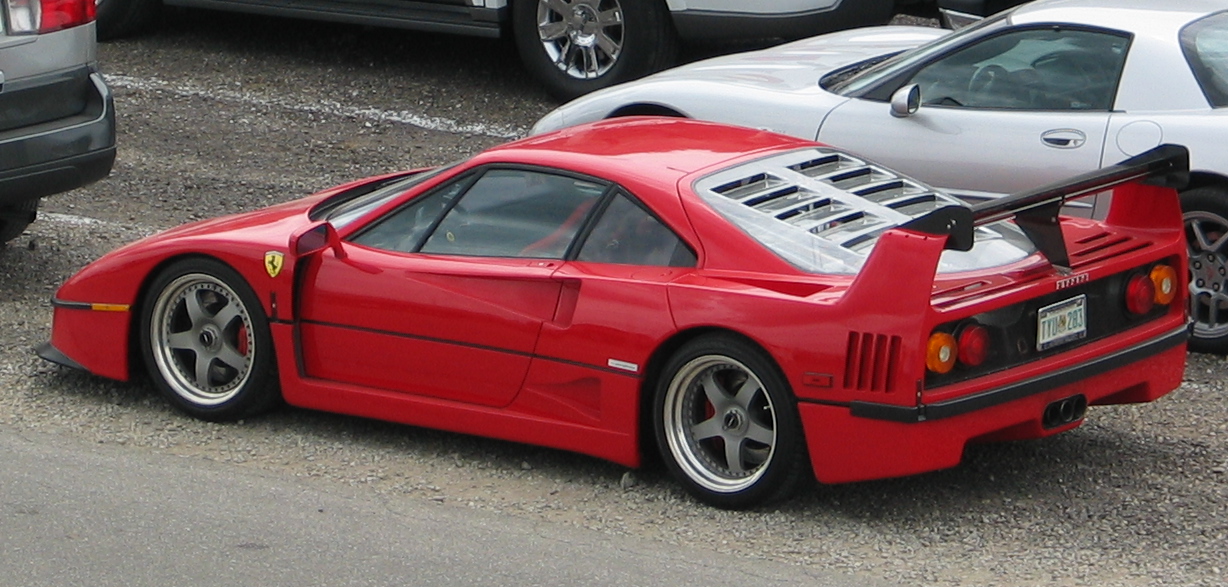
Ferrari F40: Why Enzo Ferrari Built His Final Statement
The Ferrari F40 is the last car Enzo Ferrari personally approved. Enzo Ferrari died on August 14, 1988, ten months after the F40 was revealed to the press. He saw it completed. He signed off on it. He never saw a customer take delivery.
That timing matters. The F40 exists because Enzo Ferrari wanted it to exist, and not because a market research study identified a segment opportunity. That is the gap between a product and a statement.
You can see it from fifty metres.
The Cabin That Refuses You Nothing
Climb into a Ferrari 488 and the cabin greets you. Climate control, an infotainment screen, configurable driving modes with names borrowed from racing, leather on everything that isn’t carbon. The car works hard at making itself pleasant so that you will enjoy being in it.
Climb into an F40 and the cabin puts a question to you. Drive it or get out.
No carpet. No door handles on the inside either, just a cable you pull. No sound insulation, no radio. The seats are fixed carbon tubs bolted straight to the floor, so the pedals adjust instead of the chair. The windows are Lexan rather than glass because Lexan weighs less; they don’t wind down, you slide them open along a slot. The instrument cluster is analogue, essential, exactly sufficient.
The chassis tubes show. So do the welds. Nobody did that for the look of it. Enzo specified a car that weighed 1,100 kilograms, and every kilogram of comfort had to be paid for somewhere in that budget. He settled it the way he settled everything at Ferrari, which was never a matter of picking between two good options. There was a correct answer and then there was everything else.
The F40 weighs 1,100 kilograms. The Ferrari 488 weighs 1,370 kilograms. The SF90 Stradale weighs 1,570 kilograms. The direction of travel since 1988 has been consistent.
The Engine That Made 201 mph Real
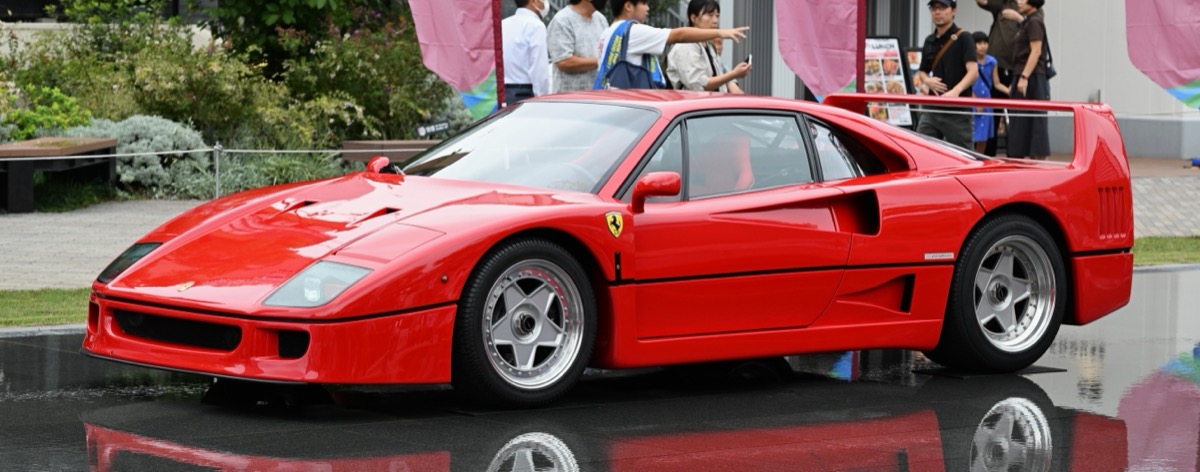
The engine is a twin-turbocharged 2.9-litre V8, Ferrari’s F120A unit, derived from the 288 GTO Evoluzione race car that came before it. Two IHI turbochargers running 16 psi of boost. Output is 478 horsepower at 7,000 rpm, torque 577 Nm at 4,000 rpm.
In 1987, 478 horsepower in a 1,100-kilogram car worked out to 435 horsepower per tonne. A current Porsche 911 GT3, the standard-bearer for analogue driving in the showrooms of today, manages 375 horsepower per tonne.
By that measure the F40 was quicker in 1987 than the GT3 is now.
Top speed: 201 mph. The number was the whole point. The F40 was the first production road car to exceed 200 mph, and Enzo understood what that meant. He was 89 years old when the car was revealed, sixty years into building cars, and he knew 200 mph was a barrier rather than a figure on a brochure. He wanted the last car built under his direct authority to be the one that went through it.
Zero to 60 mph in 3.8 seconds. The quarter mile in 11.8. Extraordinary numbers in 1987, and still competitive in 2026 against anything that hasn’t been purpose-built for acceleration.
What Enzo Actually Wanted
Ferrari built the F40 to commemorate the company’s 40th anniversary. That is the official story. The more accurate version is that Enzo Ferrari, in his final years, was alarmed by what Ferrari was becoming.
The 308 had been beautiful. The Testarossa was exotic. But the cars kept getting heavier and more comfortable, aimed increasingly at buyers who wanted the image of a Ferrari rather than the experience of driving one. The GTO (the 288 GTO, not the 1962 car) had been a limited production run that pointed at what was possible. The F40 was Enzo’s instruction to his engineers: build a car that drives like a weapon, not a product.
His specific direction, documented in multiple accounts from Ferrari engineers of the period, was a car faster than anything road-legal, as light as physics permitted, offering the driver no assistance whatsoever. No traction control. No anti-lock brakes either; the F40 launched without ABS, though it was later offered as a retrofit. He wanted a car that demanded skill and paid you back for having it.
He was 89 years old. He had been building cars his entire adult life, and he knew precisely what he was asking for and why.
The F40 is what that knowledge looks like in metal.
The Raw Cabin Story
People call the F40’s interior spartan, or minimal, or purposeful, depending on how generous they’re feeling. Polite words.
The floors are painted aluminium panels over carbon fibre. The dashboard is a single moulded carbon piece. The roll cage sits out in the open. The fuel cell is directly behind the driver with a thin carbon bulkhead between the two of you. The gear lever carries no gate pattern display, so you learn the shift pattern by driving. The handbrake is a pull handle mounted to the transmission tunnel.
Call it a racing car that tolerates road use. It was never a road car stripped down for the track.
Driving one asks for commitment on several fronts at once. The turbocharged V8 lags badly. Below 3,500 rpm the car is quick but manageable, and above 4,500 rpm, both turbos spooled, it turns violent. The delivery is anything but linear. The steering is unassisted and reports every imperfection in the surface. The brakes want real pressure from your leg. Nothing in the car will cover for a mistake.
What comes back the other way, in exchange, is unmediated. Above 5,000 rpm on a road that suits the car, the information arriving through the wheel and the seat and the pedals is complete and direct. Nothing filtered. Nothing smoothed. You know what the car is doing because the car isn’t spending any effort hiding it from you.
That experience carries a market value in 2026 of approximately $1.8 million to $2.5 million, depending on condition and provenance. New, the F40 was priced at $400,000. Appreciation on that scale is the market admitting that whatever the F40 was doing, nothing built since has done it the same way.
After Enzo
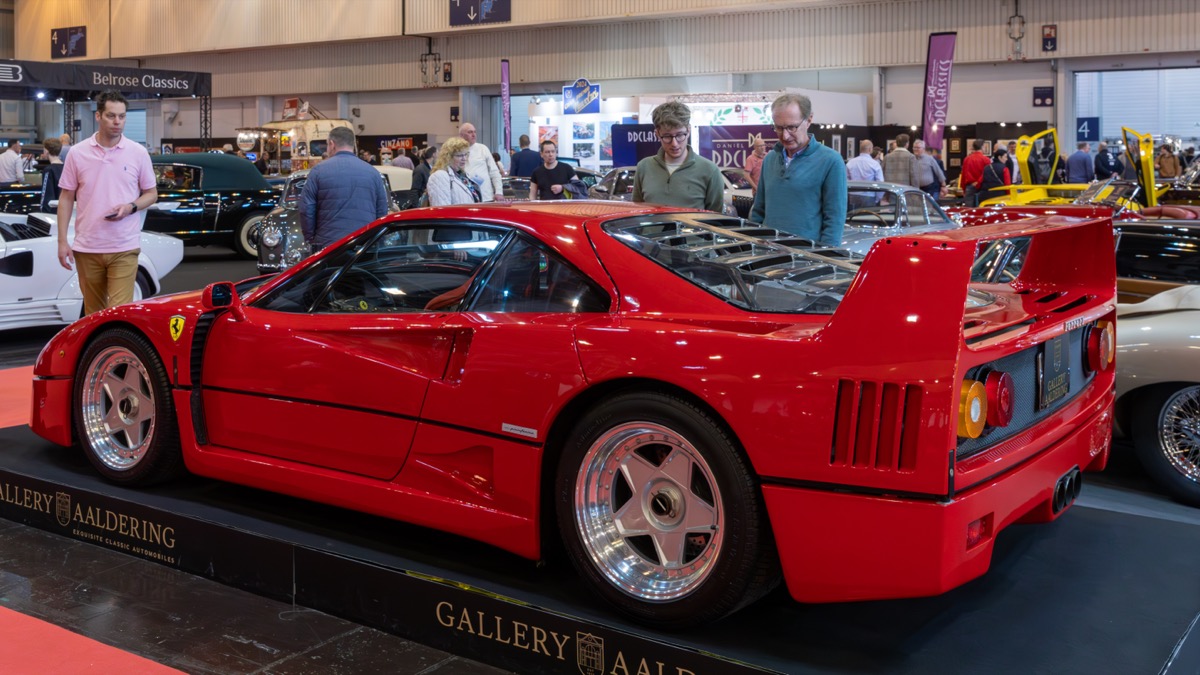
Enzo Ferrari died in August 1988. Ferrari the company, the brand, the publicly-listed entity, carried on.
The F50 arrived in 1995. Faster, more sophisticated, built around a Formula 1-derived chassis. It also weighed 1,230 kilograms, 130 kilograms more than the F40. It had power-assisted steering. The cabin was finished properly.
The Enzo followed in 2002. Carbon tub, V12, 650 horsepower, traction control, a sequential gearbox. A genuinely extraordinary machine, and a Ferrari product in a way the F40 never was.
Then LaFerrari. Then the SF90. Every generation more capable on the measurable metrics, more sophisticated in execution, and further from what Enzo specified in 1987 when he told his engineers to build a car that drives like a weapon.
None of which is a criticism of those cars. The SF90 is one of the most technically accomplished road cars in history. But it’s a product. It was built because Ferrari identified a hybrid hypercar segment and judged that taking part was strategically correct, and its name comes from the scuderia rather than from a person who cared.
The F40 doesn’t feel like a product at all. It feels like a statement made by a man who understood exactly what he was saying and chose to say it in steel, carbon, and twin turbocharged V8 at 201 miles per hour.
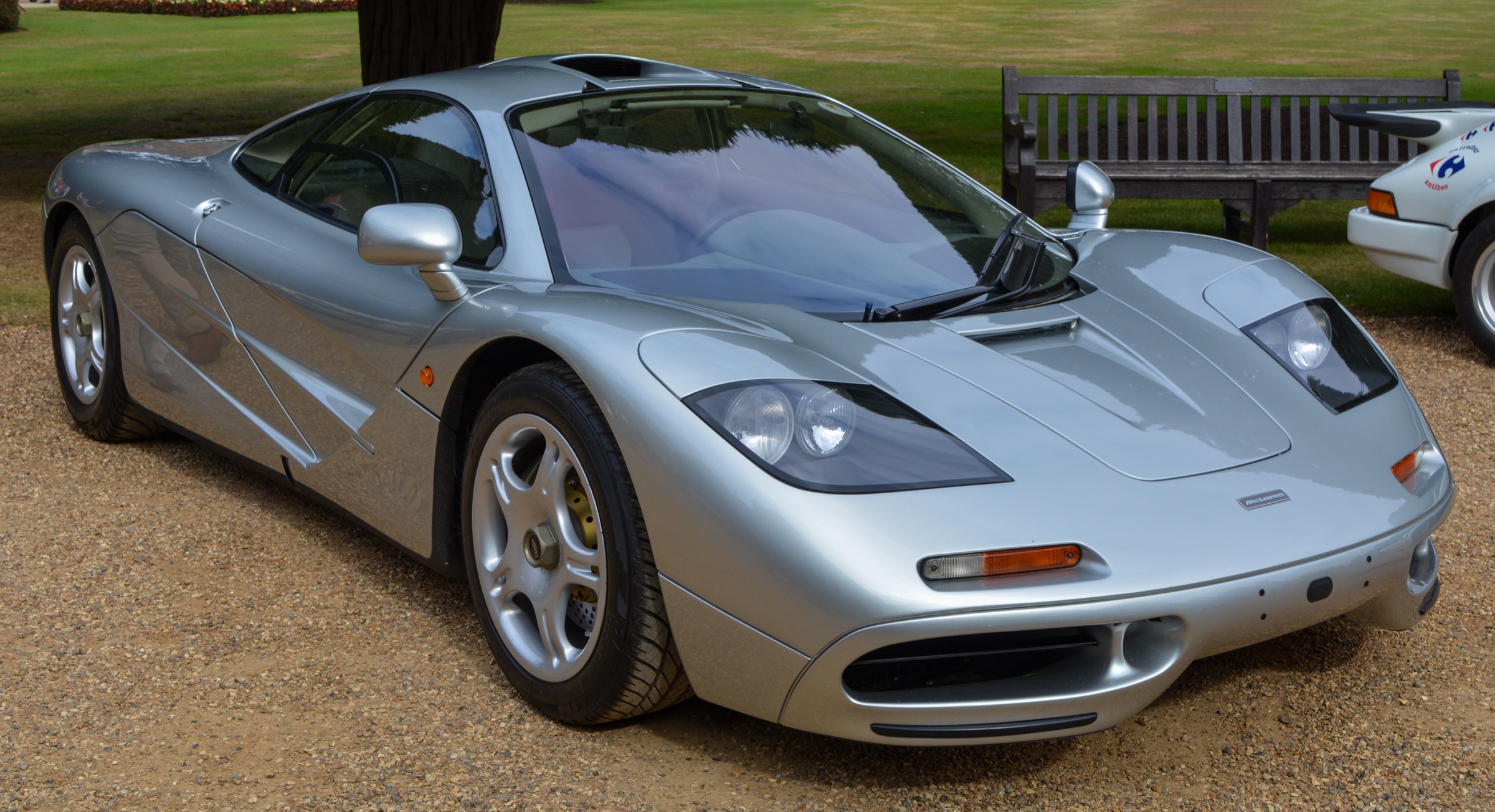
He was right, and nothing has answered it since, though the McLaren F1 made a different argument with similar conviction five years later, and the Dodge Viper ran a 25-year parallel campaign on the proposition that the driver was the safety system.
The F40 sits at the top of any honest ranking of the best exotic cars ever engineered. It earns the position the same way Enzo earned everything: by refusing every concession the conversation tried to make.
Share this
Join the conversation
COMMENTS
Loading comments…
No comments yet. Be the first to weigh in.
Leave a comment
Posted
Thanks for joining the conversation.