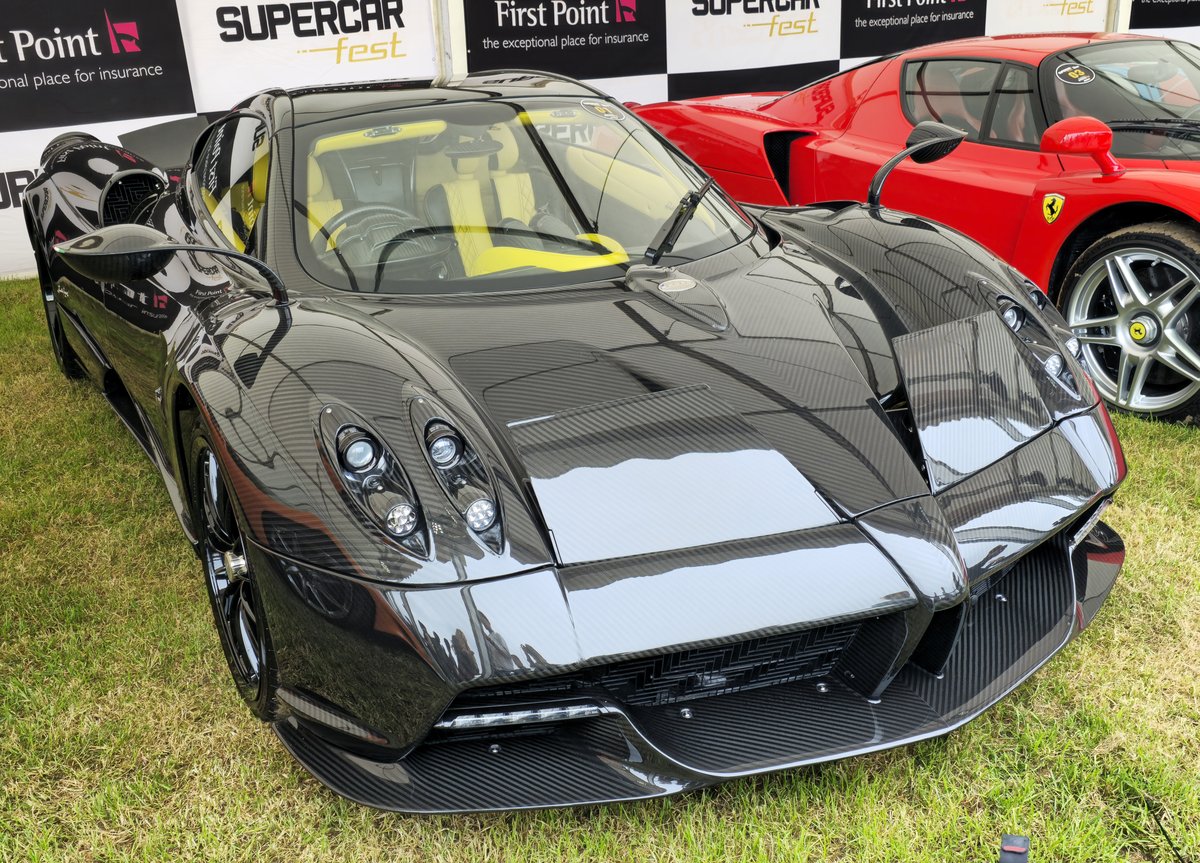
The Pagani Huayra: When Art Becomes Engineering
The Pagani Huayra costs $2.4 million. There are faster cars. There are lighter cars. There are cars with more downforce, more horsepower, more engineering efficiency per dollar spent. Horacio Pagani knows this, and he doesn’t care. The Huayra isn’t trying to win a benchmark war. It’s trying to be a complete object — and those are two very different ambitions.
The Machine Under the Skin
The engine is a Mercedes-AMG M158 twin-turbocharged V12, 6.0 liters, 730 horsepower, 1,000 Newton-meters of torque. That torque figure matters more than the horsepower here — it arrives at 2,000 rpm and it doesn’t let go. The transmission is a seven-speed sequential by Xtrac, and the whole drivetrain sits behind the driver in a mid-engine layout that puts 44 percent of the weight on the front axle.
The Huayra weighs 1,350 kilograms. For a car with this much presence — it measures 4,605mm long and 2,036mm wide — that weight figure is a small miracle. Pagani achieved it through a material called carbo-titanium, which his team developed in-house. It’s a hybrid composite weaving carbon fiber and titanium threads together, stronger than either alone, lighter than most alternatives. The monocoque is built from it. So are structural components throughout the car.
You can see the material if you look. The Huayra doesn’t hide its construction. Exposed components are finished to the same standard as visible ones because Horacio Pagani believes the parts no one sees should be made as carefully as the parts everyone sees.
That’s not an engineering philosophy. That’s an artistic one.
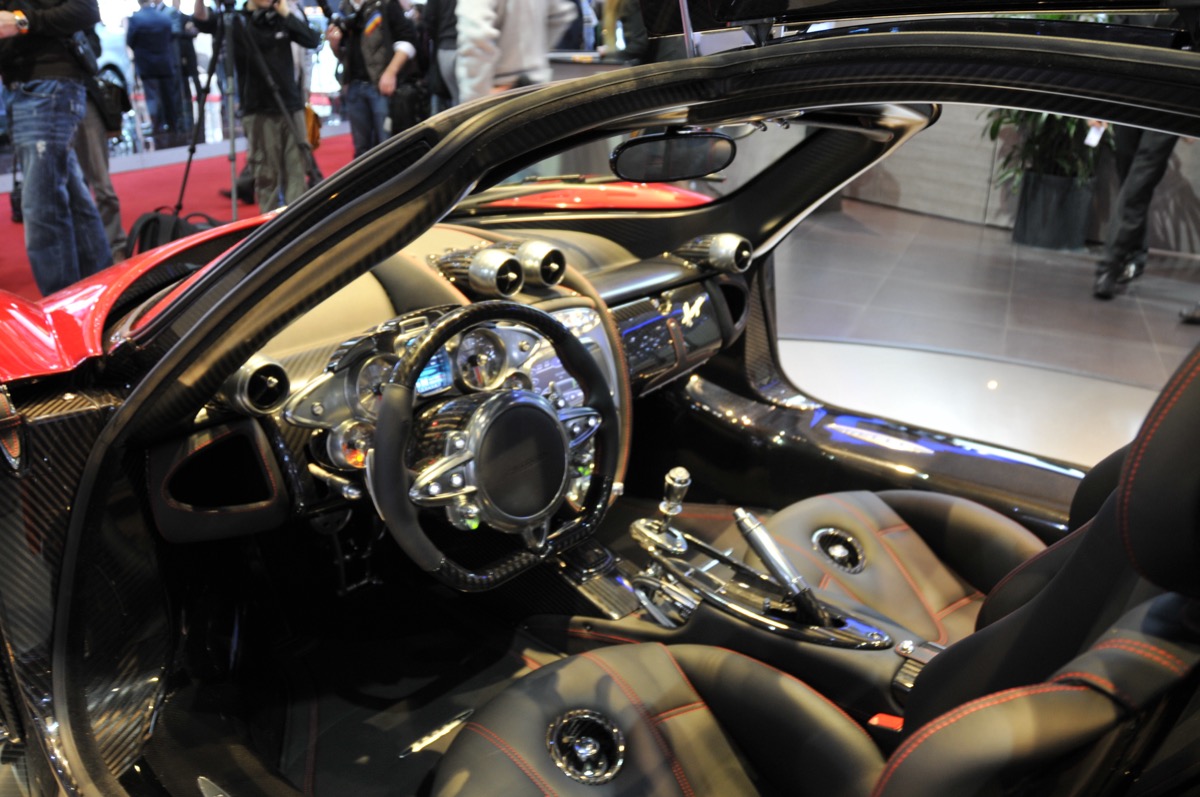
What Carbo-Titanium Actually Means
Most supercar manufacturers buy their composite solutions from suppliers. Pagani builds his own. The carbo-titanium development process took years and required building material science capability in-house at the Modena facility. The result is a composite that can be CNC-machined like a metal but retains the weight advantages of carbon.
The reason this matters isn’t just the material properties. It’s what the material enabled — complex, curved, structurally integrated bodywork that behaves as sculpture rather than sheetmetal pressed into shapes. The Huayra’s flanks aren’t flat. Nothing on this car is flat. Every surface describes a curve that transitions into another curve, and those curves serve aerodynamic functions while being beautiful in themselves.
The four active aerodynamic flaps — two at the front, two at the rear — adjust independently based on steering angle, yaw rate, and throttle input. The system, developed with Bosch, adjusts to 12 different configurations as you drive. The Huayra doesn’t have a traditional rear wing. It doesn’t need one.
This is what separates Pagani from the design-by-committee manufacturers. Every decision is integrated. Nothing is bolted on after the fact.
The Analogue Interior in a Digital Era
Slide into the Huayra and the first thing you notice is the gauges. They’re analogue — actual needles sweeping across actual dials. In 2011, when the Huayra launched, every competitor was moving toward digital displays. Pagani went the other direction.
This was a deliberate argument. Horacio Pagani believes that the experience of driving a $2.4 million car should feel physical and tactile and connected to the machine’s actual state, not mediated through a screen. The gauges are machined aluminum. The shift paddles are titanium. The exposed bolts throughout the interior are aerospace-specification fasteners, torqued to a specification and then safety-wired, the same way aircraft engines are serviced.
The gull-wing doors open on a mechanism that Pagani designed in-house. They sweep up and forward, giving access to an interior that’s leather and aluminum and exposed composite, lit by ambient light coming through the glass roof. Sitting inside, you’re surrounded by visible craftsmanship — not hidden behind trim panels, not covered in soft-touch plastic, but present and tactile and real.
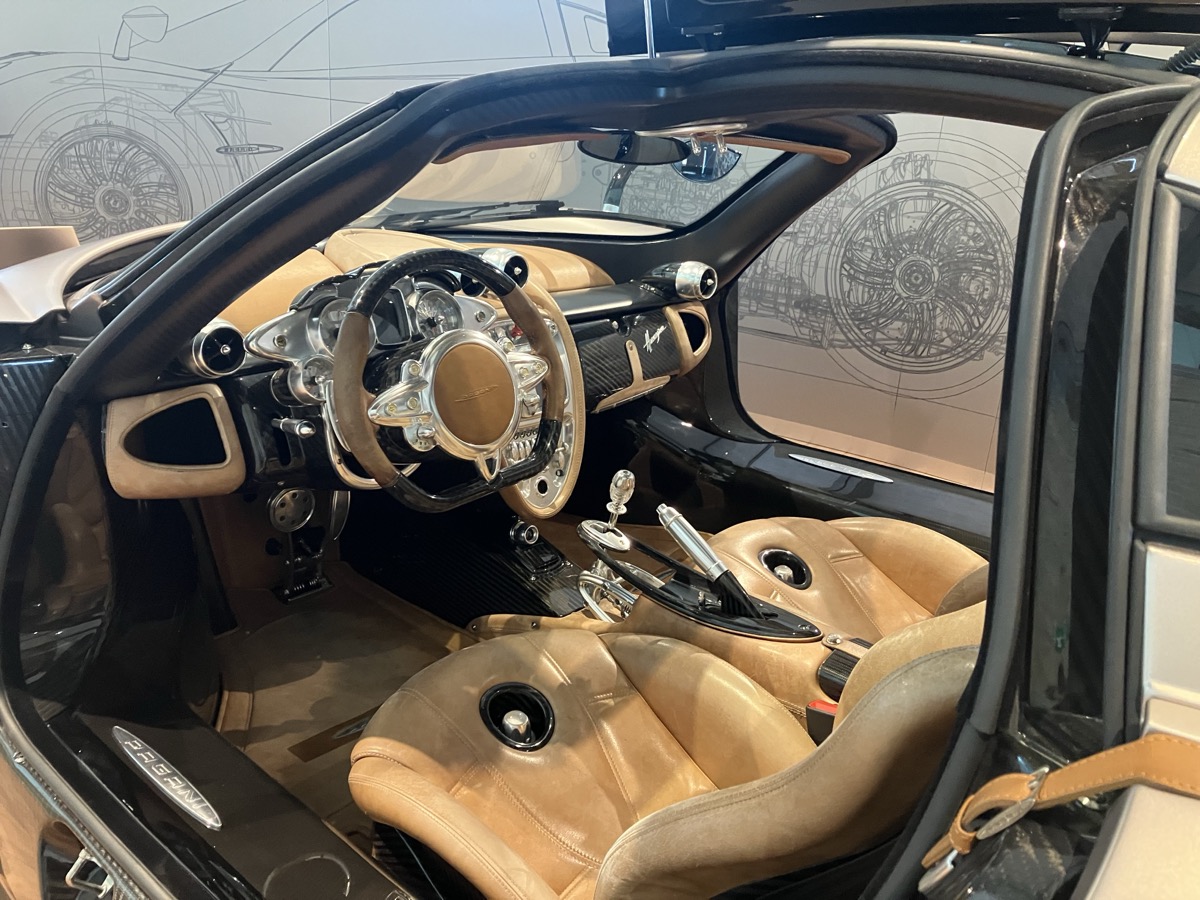
The human hand touched every part of this car. That’s visible when you sit in it.
One Hundred Cars Per Year, On Purpose
Pagani could build more. The production facility in San Cesario sul Panaro employs around 160 people and the infrastructure exists to scale. The cap at roughly 100 cars per year across all variants is a choice, not a constraint.
The reasoning is that each car requires 5,000 hours of assembly labor. That figure isn’t an apology for inefficiency. It’s the point. Each monocoque is hand-laminated. Each component is inspected at multiple stages. Each completed car is driven by a Pagani test driver before delivery. You cannot accelerate 5,000 hours of human attention without losing what makes the attention valuable.
The waiting list for a Huayra runs years. Customers specify their cars in extraordinary detail — Pagani’s options catalog runs to thousands of combinations of paint, leather, carbon finish, and metalwork. No two Huayras are identical. That’s not a marketing line. It’s an operational reality at 100 cars per year.
Ferrari builds around 13,000 cars per year. Lamborghini builds around 10,000. Pagani builds 100. The exclusivity isn’t manufactured — it’s a direct consequence of refusing to compromise the process.
Being Near One
The photographs don’t prepare you. Every automotive journalist who has spent time with the Huayra comes back with the same observation: the scale surprises you, the detail overwhelms you, and the overall effect is unlike any other car.
It’s not just that the Huayra is beautiful. It’s that it rewards extended looking. The more time you spend with it, the more you find — the precision of a small bracket, the way a surface catches light, the integration of a cooling duct into the bodywork. It’s designed to be studied, not just seen.
At speed, the experience is dominated by the V12. Twin turbochargers mean there’s no traditional surge of power at high revs — torque is present everywhere, and the engine builds cleanly through its range to a 6,500 rpm redline that sounds like a kettle drum orchestra played by someone with a grudge. The chassis communicates. The steering tells you what the front tires are doing. Nothing is filtered out.
The Huayra is not comfortable. It’s precise. Those are different things, and Pagani made a choice about which one mattered.
Some Objects Shouldn’t Be Optimized
The efficient hypercar argument goes like this: maximum performance, minimum weight, aerodynamics perfected by simulation, manufacturing refined to reduce cost and time. The Koenigsegg Jesko runs this argument to its logical conclusion. The McLaren P1 makes it financially. The Ferrari SF90 XX Stradale runs it through track-car homologation, and even the Lamborghini Revuelto — for all its naturally-aspirated-V12 preservation — is an optimization story, where electrification is added in service of a measurable outcome. The modern hypercar is the product of optimization.
The Huayra rejects the premise. It argues that optimization is a category error when applied to certain objects. A violin isn’t optimized — it’s completed. A Patek Philippe watch isn’t optimized — it’s finished. The distinction matters because an optimized object has a theoretical maximum, and once you reach it, there’s nothing left. A completed object has integrity. It’s not trying to be better than something else. It’s trying to be fully itself.
Horacio Pagani is building completed objects in Modena at the rate of 100 per year. The 730 horsepower is correct for the car. The 1,350 kilograms is correct for the car. The analogue gauges are correct for the car. Every specification is determined by what the object needs to be itself, not by what the benchmarks require.
That’s why the Huayra costs $2.4 million, and why it’s worth it, and why there will never be a discount.
Some objects shouldn’t be optimized. They should be completed. The Huayra is complete.
Share this

Join the conversation
COMMENTS
Loading comments…
No comments yet. Be the first to weigh in.
Leave a comment
Posted
Thanks for joining the conversation.